Crop Rotation for Soil Health: A Practical Farm Guide
Healthy soil is essential for productive farming. It provides plants with nutrients, water, and the support they need to grow. However, growing the same crop repeatedly in the same field can increase pest pressure, encourage certain diseases, and place repeated demands on particular soil nutrients.
Crop rotation for soil health is a practical farming method that helps maintain soil fertility, improve nutrient management, and support sustainable crop production. By growing different crops in a planned sequence, farmers can make better use of soil resources and improve the long-term productivity of their land.
In this guide, we will explain what crop rotation is, its benefits, suitable crop rotation examples, and how farmers can develop an effective rotation plan.
What Is Crop Rotation?
Crop rotation is the practice of growing different crops in the same field in a planned sequence over different growing seasons or years.
For example, a farmer may grow wheat in one season and a suitable legume crop in the next. These crops have different nutrient requirements and growth characteristics, helping diversify the demands placed on the soil.
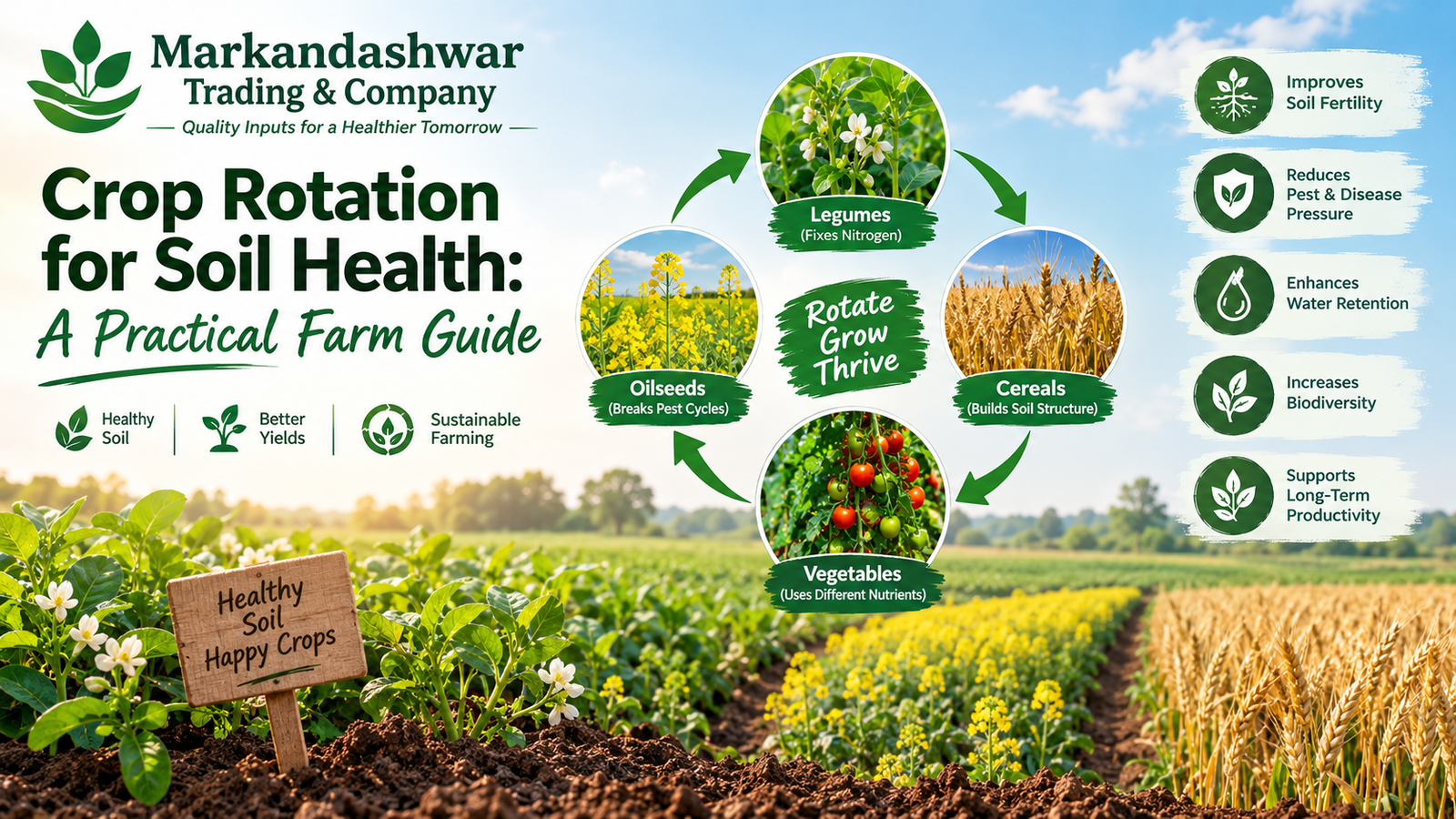
A well-planned Crop Rotation for Soil Health may include cereals, legumes, oilseeds, vegetables, and cover crops, depending on the local climate, soil type, irrigation availability, and market demand.
Unlike monocropping, which involves repeatedly growing the same crop, crop rotation introduces diversity into the farming system.
Why Is Crop Rotation Important for Soil Health?
Soil health depends on several factors, including nutrient availability, organic matter, soil structure, water movement, and biological activity. Crop rotation can support these factors when the crops are selected and managed appropriately.
1. Helps Maintain Soil Fertility
Different crops use nutrients in different amounts and proportions. Rotating crops can help diversify nutrient demands and reduce repeated pressure on the same soil resources.
Legume crops, such as chickpeas and peas, can form associations with nitrogen-fixing bacteria. These bacteria convert atmospheric nitrogen into forms that contribute to the plant’s nitrogen supply.
Some nitrogen may remain in roots and crop residues after harvest. The amount available to the next crop depends on residue management, decomposition, and other soil conditions.
2. Improves Soil Structure
Different crops have different root systems. Some develop deeper roots, while others have more concentrated roots near the soil surface.
Using crops with varied root structures can help create soil pores, support aggregation, and improve the movement of air and water through the soil.
Combining Crop Rotation for Soil Health with appropriate residue management and reduced unnecessary tillage can provide additional soil-health benefits.
3. Helps Break Pest and Disease Cycles
Many crop pests and pathogens are associated with particular plant families or host crops. Repeatedly growing the same crop can allow certain pests and diseases to persist.
Introducing a non-host crop may interrupt their life cycles and reduce their buildup.
However,Crop Rotation for Soil Health does not control every pest or disease. Farmers should consider the pest’s host range, survival period, and local disease conditions before selecting the next crop.
4. Supports Soil Biological Activity
Different crops provide different types and amounts of root exudates and crop residues. These materials support a diverse community of soil microorganisms.
Crop Rotation for Soil Health can help create a more varied food supply for soil organisms, contributing to nutrient cycling and biological soil processes.
5. Helps Manage Soil Moisture
Crops differ in their rooting depth, growing period, and water requirements. Choosing crops that suit the available water supply can help farmers manage irrigation more effectively.
Crop Rotation for Soil Health alone does not guarantee better water retention. Soil texture, organic matter, drainage, irrigation practices, and crop selection all influence water availability.
6. Supports Long-Term Farm Productivity
A planned Crop Rotation for Soil Health can reduce dependence on a single crop and spread production risks across different growing seasons.
It may also help farmers manage input requirements, improve soil conditions, and make better use of available land. Actual results depend on the rotation design, crop prices, weather, and farm management.
Best Crops to Include in a Crop Rotation Plan
The most suitable crops depend on local conditions and farming goals. The following groups are commonly considered when designing a rotation.
1. Cereal Crops
Examples include wheat, maize, rice, and other cereal crops.
Cereals provide food and feed and are important components of many farming systems. However, repeatedly growing the same cereal may increase certain pest, disease, or nutrient-management challenges.
2. Legume Crops
Examples include chickpeas, peas, lentils, beans, and suitable forage legumes.
Legumes can contribute to nitrogen fixation when compatible nitrogen-fixing bacteria are present and conditions are suitable. They are therefore valuable components of many crop rotation plans.
3. Oilseed Crops
Examples include mustard, sunflower, and other locally suitable oilseeds.
Oilseeds may diversify the crops grown in a field and change the pattern of nutrient use and pest exposure. Their suitability depends on climate, soil, water availability, and market demand.
4. Vegetable Crops
Vegetables such as tomatoes, potatoes, and other locally suitable crops can be included in some rotation systems.
Farmers should consider their nutrient requirements, disease risks, irrigation needs, and compatibility with the previous crop.
5. Cover Crops
Cover crops are grown primarily to protect and improve the soil rather than for direct harvest.
Depending on the species, they can help protect soil from erosion, provide ground cover, contribute organic matter, and support soil biological activity.
Choose cover crops that fit the local season and avoid species that could introduce unwanted pests or compete excessively for water.
Crop Rotation Examples for Indian Farmers
Crop rotation plans should be adjusted to local soil, rainfall, irrigation, climate, and market conditions. The following are examples for planning purposes, not universal prescriptions.
| Rotation example | Potential benefit |
|---|---|
| Wheat followed by chickpea | Diversifies crop families and may contribute nitrogen through legume activity |
| Maize followed by a suitable legume | Diversifies rooting patterns and nutrient requirements |
| Rice followed by a suitable pulse crop | Can diversify production where soil, drainage, and water conditions permit |
| Cereal followed by mustard | Introduces a different crop family and may interrupt some crop-specific pest cycles |
| Vegetable crop followed by a suitable cover crop | Can protect the soil and add organic matter |
For farmers in Haryana, wheat–legume rotations may be worth considering where irrigation, soil conditions, and local recommendations support them. Rice-based systems require particular attention to drainage, water availability, and the suitability of the following crop.
How to Create an Effective Crop Rotation for Soil Health
A successful rotation begins with understanding the field and choosing crops that work well in sequence.
Step 1: Test Your Soil
Soil testing provides information about pH, nutrient status, and, where tested, salinity and other limitations.
Use the results to identify nutrient deficiencies and determine whether soil amendments or fertilizer adjustments are needed.
Step 2: Identify Your Main Crop
Start with the crop that is most important to your farm. Consider its growing season, water requirements, market demand, and common pest or disease problems.
Step 3: Choose a Different Crop Family
Where possible, select the next crop from a different plant family, especially when the main goal is to manage crop-specific pests and diseases.
Changing crops within the same family may not provide the same benefits as changing to a non-host crop.
Step 4: Include Legumes Where Suitable
Legumes can contribute nitrogen through biological nitrogen fixation. Their contribution depends on the crop, bacterial compatibility, soil conditions, and management.
Do not assume that legumes eliminate the need for nitrogen fertilizer in the following crop. Nutrient planning should consider soil tests and locally recommended guidance.
Step 5: Manage Crop Residues
Crop residues can protect the soil surface, contribute organic matter, and return nutrients as they decompose.
Manage residues according to the crop, disease risks, planting system, and local recommendations.
Step 6: Monitor the Results
Record crop growth, yields, pest problems, irrigation use, and fertilizer applications. Periodic soil testing can help you evaluate whether your rotation is improving soil conditions over time.
Role of Fertilizers and Biofertilizers in Crop Rotation for Soil Health
Crop rotation and suitable agricultural inputs can work together to support crop nutrition and soil management.
Organic and conventional fertilizers: These provide nutrients needed for plant growth. The appropriate type and quantity should be based on soil tests, crop requirements, and local recommendations.
Biofertilizers: These contain beneficial microorganisms that support specific nutrient-related processes. Examples include Rhizobium products for compatible legumes and phosphate-solubilizing microorganisms for suitable crops and conditions.
Organic matter: Properly managed compost, manure, and crop residues can contribute organic matter and improve certain soil properties.
Farmers should select inputs according to the crop and soil conditions. Biofertilizers and organic inputs should not be assumed to replace all recommended fertilizers.
Common Crop Rotation Mistakes to Avoid
To get the best results from crop rotation, avoid these common mistakes:
- Growing crops with similar pest and disease problems in consecutive seasons.
- Choosing crops without considering water availability.
- Ignoring soil testing and nutrient requirements.
- Assuming every legume fixes the same amount of nitrogen.
- Selecting cover crops that may compete with the following crop for water.
- Ignoring crop residue management and disease risks.
- Following a rotation plan without considering market demand and local conditions.
The most effective rotation is one that balances soil health, crop productivity, water availability, pest management, and farm economics.
Conclusion
Crop rotation for soil health is a valuable practice for farmers who want to manage soil fertility, diversify crop production, and support long-term agricultural productivity.
By alternating suitable cereals, legumes, oilseeds, vegetables, and cover crops, farmers can diversify nutrient demands, support soil biological activity, and interrupt certain pest and disease cycles.
At Markandashwar Trading & Company, we believe that healthy soil and informed agricultural decisions are essential for responsible farming. Combine suitable crop rotation with soil testing, balanced fertilizer use, and appropriate irrigation practices to support better farm management.
Healthy soil today can help build a stronger foundation for tomorrow’s crops.
Frequently Asked Questions (FAQs)
1. What is crop rotation in agriculture?
Crop Rotation for Soil Health is the practice of growing different crops in the same field in a planned sequence over successive growing seasons or years.
2. How does crop rotation improve soil health?
It can diversify nutrient demands, support soil biological activity, improve soil structure through varied root systems, and interrupt certain pest and disease cycles.
3. Which crop rotation is best for soil fertility?
The best rotation depends on the soil, climate, water supply, and farming system. Including suitable legumes can contribute nitrogen through biological nitrogen fixation.
4. Can crop rotation reduce fertilizer use?
Crop Rotation for Soil Health may improve nutrient management and help reduce certain input requirements in some systems. However, fertilizer needs should still be determined by soil tests and crop requirements.
5. How often should farmers rotate crops?
Rotation schedules depend on crop type, local pest and disease risks, climate, and farm goals. Some benefits may require several growing seasons to develop.
6. Is crop rotation suitable for small farms?
Yes. Small farms can use Crop Rotation for Soil Health by planning different crops across available plots or successive seasons, depending on water, labor, and market conditions.
7. What is the difference between crop rotation and intercropping?
Crop Rotation for Soil Health involves growing different crops in sequence over time. Intercropping involves growing two or more crops together in the same field during overlapping growing periods.