Compost Maturity for Soil Health: A Farmer’s Guide
Introduction
Healthy soil is the foundation of productive agriculture. Farmers can improve soil conditions by managing organic matter, maintaining balanced nutrients, and using quality compost. However, compost must be sufficiently decomposed before it is applied to crops.
Compost maturity is an important factor in determining whether compost is suitable for agricultural use. Mature compost can support soil structure, improve water retention, and contribute to nutrient management. Immature compost, on the other hand, may release compounds that affect seed germination and plant growth. Source: UF/IFAS Extension
In this guide, we explain how to identify mature compost, understand its benefits, avoid common mistakes, and use compost effectively for healthier soil.
What Is Compost Maturity?
Compost is produced when microorganisms break down organic materials such as crop residues, dry leaves, vegetable waste, and other suitable biodegradable matter.
During decomposition, microorganisms transform the original materials into a more stable, soil-like product. The process generally includes an active decomposition stage followed by a curing period.
Compost maturity describes how suitable the finished material is for its intended use. Mature compost is generally stable, has an earthy smell, and is less likely to harm plants when applied appropriately.
Composting vs. Curing
Composting is the process of breaking down organic materials. During active composting, microbial activity can generate considerable heat.
Curing follows the active stage and allows the material to stabilise further. During this period, decomposition continues at a slower rate and the compost becomes more suitable for use.
The time required depends on the materials, moisture, aeration, temperature, and management method. Compost should not be considered ready based on age alone.
Why Is Compost Maturity Important for Soil Health?
Farmers should assess the condition of compost before adding it to agricultural land. The quality of compost influences its usefulness as a soil amendment.
1. Supports Better Soil Structure
Well-made compost adds organic matter to soil. This can help improve aggregation, soil structure, and workability. The benefits depend on the soil type and the quantity and quality of compost applied.
2. Helps Improve Water Retention
Organic matter can help soil retain water and improve its physical condition. This is particularly useful in soils that have limited water-holding capacity, although results vary by soil type.
3. Contributes to Nutrient Management
Compost maturity contains nutrients that can become available to plants over time. The amount and speed of nutrient release depend on the compost’s composition and the soil environment.
Farmers should not assume compost provides all the nutrients a crop needs. Soil testing and crop-specific recommendations remain important.
4. Reduces Risks from Unfinished Compost
Immature compost may contain organic acids or excess ammonia that can injure sensitive plants. Its continued decomposition may also temporarily tie up nitrogen that crops need.
Recognising compost maturity helps farmers decide whether a batch needs additional curing before application. Source: NC State Extension
Five Signs of Mature Compost
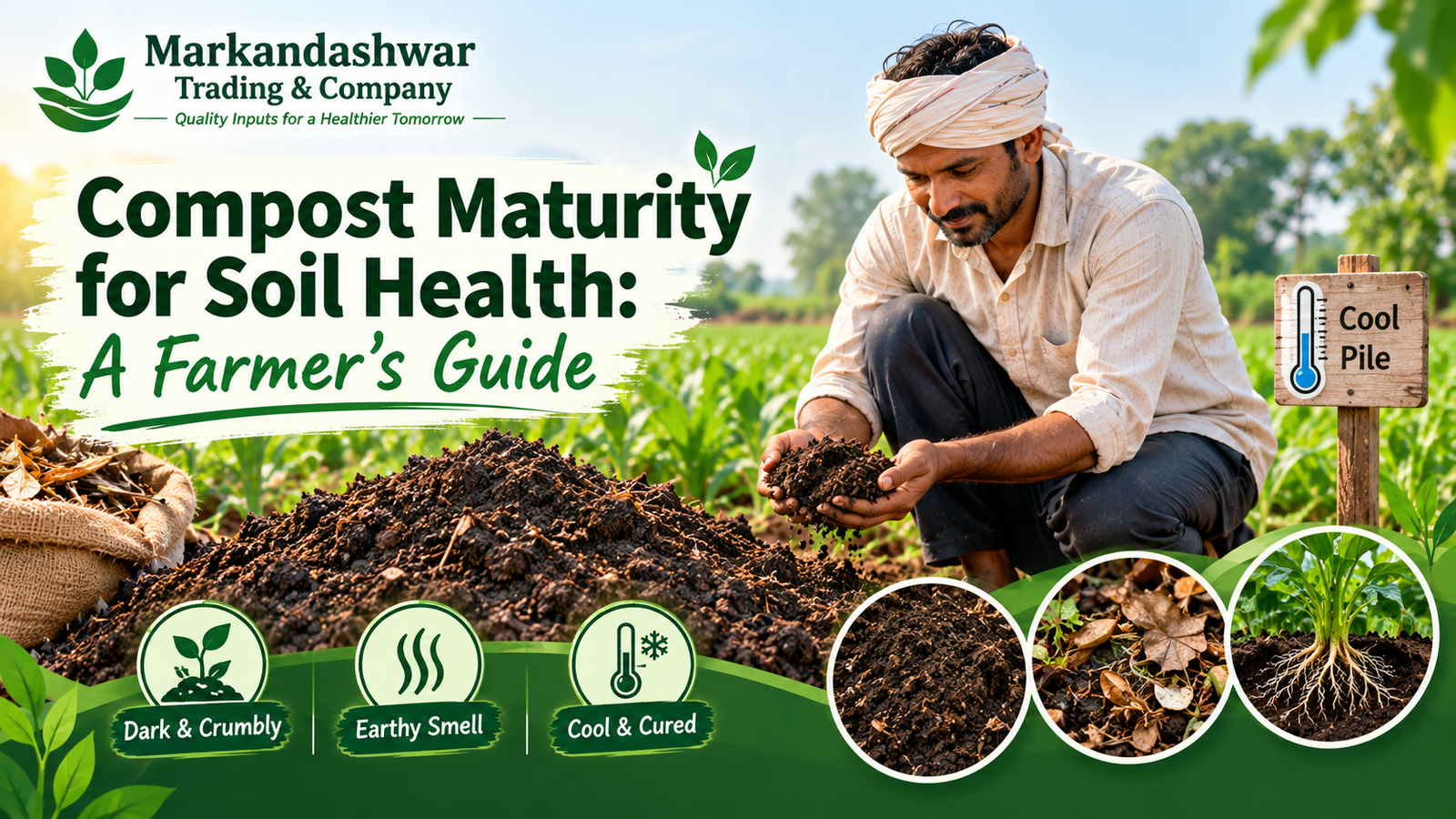
Farmers can use several practical indicators to assess whether compost is ready. No single visual sign guarantees that compost is fully mature, so consider several indicators together.
1. Dark Brown Colour
Mature compost is often dark brown to nearly black. Its colour can vary according to the materials used, so colour alone is not enough to confirm readiness.
2. Crumbly Texture
Finished compost generally has a crumbly, soil-like texture. Most original materials should no longer be easily recognisable, although some woody pieces may remain.
3. Earthy Smell
Mature compost usually smells earthy, similar to damp soil or woodland. A strong sour, rotten, or ammonia-like smell may indicate that the compost needs more decomposition or better aeration.
4. Stable Temperature
A compost pile that has cooled to approximately the surrounding air temperature and remains cool is often nearing the end of active decomposition. Temperature should be checked over time rather than judged from a single reading.
5. Reduced Original Volume
As organic materials decompose, the pile typically becomes smaller. A reduction in volume is a useful sign of decomposition, but it does not independently prove maturity.
Together, these indicators provide a practical first assessment of compost maturity before use on the farm. Source: University of Florida IFAS Extension
How to Check Compost Maturity on the Farm
Farmers can follow these steps to assess a compost batch.
Step 1: Observe the Appearance
Check whether the compost is dark, crumbly, and mostly uniform. Look for large quantities of recognisable food scraps, fresh plant materials, or manure clumps.
Step 2: Check the Smell
Take a small sample and smell it carefully. An earthy smell is generally a positive sign. If the compost smells sour or strongly of ammonia, allow more time for curing and check whether the pile needs aeration.
Step 3: Monitor Temperature
Use a compost thermometer if available. Measure the pile over several days and compare its temperature with the surrounding air. A pile that continues heating may still be actively decomposing.
Step 4: Check Moisture
Compost maturity should generally be moist rather than waterlogged. If it is extremely wet, improve drainage and aeration. If it is too dry, controlled moisture may help decomposition continue.
Step 5: Consider a Laboratory Test
For commercial farming or large-scale compost production, laboratory analysis can provide more reliable information. Depending on the intended use, tests may assess pH, electrical conductivity, carbon-to-nitrogen ratio, ammonium, nitrate, stability, and plant response.
These steps help farmers assess compost maturity more carefully than relying on colour or age alone. Source: Oregon State University Extension
Factors That Affect Compost Maturity
Several factors determine how quickly compost becomes stable and suitable for use.
1. Type of Organic Materials
Green materials, dry leaves, crop residues, and woody materials decompose at different rates. Chopping larger materials into smaller pieces can help them break down more evenly.
2. Moisture
Microorganisms need suitable moisture to decompose organic matter. Excessive dryness slows activity, while waterlogged conditions can restrict oxygen and produce unpleasant odours.
3. Aeration
Adequate oxygen supports aerobic decomposition. Turning the pile when necessary can help introduce air and improve the breakdown of organic materials.
4. Temperature
Microbial activity changes as the pile heats and cools. Temperature depends on pile size, materials, moisture, and management.
5. Carbon and Nitrogen Balance
Microorganisms need both carbon and nitrogen. Dry leaves and straw provide carbon-rich material, while green plant residues and some other organic materials contribute more nitrogen.
A suitable mixture supports decomposition, although the ideal balance depends on the materials being composted.
6. Curing Time
Even after active heating ends, compost may need additional time to stabilise. The curing period varies with the composting system and intended use.
Managing these factors can improve the consistency and quality of compost produced on the farm.
How to Use Mature Compost in Agriculture
Once compost is sufficiently mature and suitable for the intended crop, farmers can incorporate it into their soil management plan.
Before Sowing
Apply Compost maturity according to soil conditions, crop requirements, and local agricultural recommendations. Incorporating suitable compost before sowing can help add organic matter to the soil.
Around Established Crops
Compost may be used as a surface amendment or mulch where appropriate. Avoid piling it directly against plant stems, and follow crop-specific recommendations for application.
In Orchards and Vegetable Fields
Mature compost can be useful in orchard soils and vegetable production systems. The application rate should consider soil nutrient status, compost analysis, crop demand, and any applicable local guidance.
As Part of Integrated Nutrient Management
Compost works best as part of a broader plan that includes soil testing, appropriate fertiliser use, irrigation management, and suitable crop practices.
Remember that compost maturity does not automatically mean the compost has the ideal nutrient composition for every crop. Quality and nutrient content should also be considered.
Common Mistakes Farmers Should Avoid
Farmers can improve Compost maturity quality by avoiding these common mistakes:
- Using compost too early: Allow sufficient decomposition and curing before applying it to sensitive crops.
- Judging only by colour: Dark compost may still need more time to stabilise.
- Ignoring unpleasant odours: Strong sour or ammonia-like smells can indicate a problem.
- Allowing the pile to become waterlogged: Excess moisture can limit oxygen and slow decomposition.
- Applying too much compost: Repeated heavy applications can contribute to excess salts or nutrient imbalances.
- Ignoring contamination: Avoid composting materials that may introduce harmful chemicals or unsuitable contaminants.
- Assuming compost replaces all fertilisers: Compost nutrient release varies, and crops may need additional nutrients.
Benefits of Mature Compost for Sustainable Farming
When properly produced and used, mature compost can support several aspects of soil management.
- Adds organic matter to soil.
- Can improve soil structure and workability.
- Helps increase water-holding capacity in suitable soils.
- Contributes nutrients over time.
- Supports biological activity in soil.
- Helps recycle suitable organic residues.
- Can complement integrated nutrient management practices.
The benefits depend on compost quality, soil type, crop requirements, and application practices. Testing is especially useful when compost is purchased in bulk or applied regularly.
Conclusion
Compost is a valuable resource for farmers who want to improve soil management and recycle suitable organic materials. However, its effectiveness depends on proper preparation, curing, and appropriate application.
Understanding compost maturity helps farmers identify whether a compost batch is ready for agricultural use. Dark colour, a crumbly texture, an earthy smell, and a stable temperature are useful indicators, but laboratory analysis may be needed for more reliable quality assessment.
Markandashwar Trading & Company encourages farmers to make informed agricultural decisions based on soil conditions, compost quality, and crop-specific recommendations. Using suitable compost alongside balanced nutrient management can contribute to healthier soil and sustainable farming.
Frequently Asked Questions
1. What is compost maturity?
It describes how stable and suitable compost is for its intended use. Mature compost is generally earthy-smelling, crumbly, and no longer actively heating.
2. How can farmers tell whether compost is ready?
Check its appearance, smell, texture, and temperature over time. Laboratory testing can provide additional information when compost quality is especially important.
3. How long does compost take to mature?
The time varies with the materials, moisture, temperature, aeration, pile size, and management method. Some systems produce compost in a few months, while others take considerably longer.
4. Can immature compost damage plants?
Yes. Immature compost may contain compounds that harm sensitive plants, and continued decomposition can temporarily reduce available nitrogen.
5. Does mature compost contain nutrients?
Yes. Compost maturity contains nutrients, but concentrations vary. Soil testing and compost analysis can help farmers understand how it fits into a crop nutrition plan.
6. Can compost replace chemical fertilisers?
Not necessarily. Compost maturity can complement fertilisers, but its nutrient content and release rate may not meet every crop’s needs.
7. Should compost be tested before farm application?
Testing is particularly useful for large quantities, commercial production, repeated applications, or when the source and nutrient composition are uncertain. Follow local agricultural recommendations.