
Biofertilizer vs Chemical Fertilizer: A Practical Guide for Farmers
Choosing the right fertilizer is an important part of successful farming. Farmers need to provide crops with essential nutrients while maintaining soil fertility and managing input costs. Understanding the difference between biofertilizer vs chemical fertilizer can help farmers make better decisions for their fields.
Biofertilizers contain beneficial microorganisms that support natural nutrient-related processes in the soil or around plant roots. Chemical fertilizers, also called mineral fertilizers, supply specific plant nutrients such as nitrogen, phosphorus, and potassium in concentrated forms.
Both have different roles in crop production. Rather than choosing one automatically over the other, farmers should consider crop requirements, soil-test results, irrigation, product quality, and local agricultural recommendations.
In this guide, we compare biofertilizers and chemical fertilizers, explain their advantages and limitations, and discuss how they can fit into a balanced nutrient management plan.
What Is a Biofertilizer?
A biofertilizer is a product containing beneficial living microorganisms that help improve nutrient availability or support plant growth through biological processes.
These microorganisms can help fix atmospheric nitrogen, make certain soil nutrients more available, or support nutrient uptake by plants. Their performance depends on the microbial strain, crop compatibility, soil conditions, product quality, and application method.
Common Types of Biofertilizers
- Rhizobium: Helps compatible legume crops, such as chickpea and peas, fix atmospheric nitrogen through root nodules.
- Azotobacter: Can support nitrogen-related nutrition in suitable cropping systems.
- Azospirillum: Interacts with plant roots and may support plant growth in compatible crops.
- Phosphate-solubilizing bacteria (PSB): Help make certain forms of soil phosphorus more available.
- Mycorrhizal biofertilizers: Contain beneficial fungi that can help compatible plants access nutrients, especially phosphorus.
- Potassium-mobilizing microorganisms: Help make certain forms of soil potassium more available under suitable conditions.
Different products have different functions. Farmers should select a biofertilizer based on the crop, the microorganism it contains, and the manufacturer’s instructions.
What Is a Chemical Fertilizer?
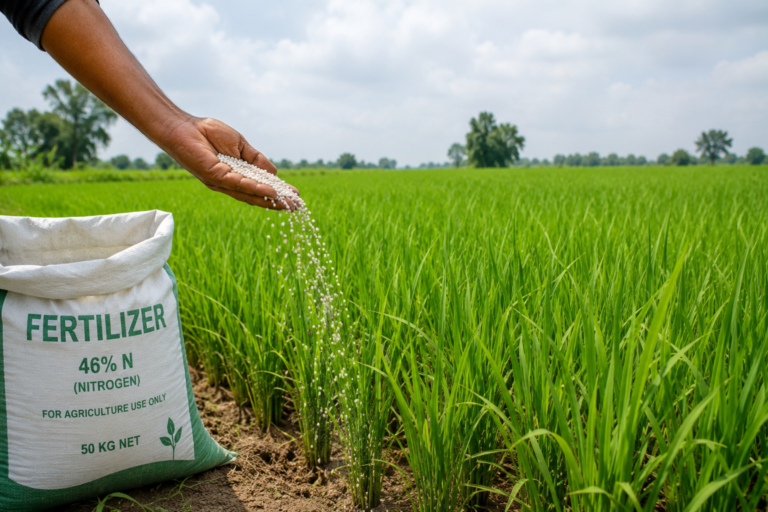
Chemical fertilizers, commonly called mineral or inorganic fertilizers, supply specific nutrients that crops need for growth and development. Many are manufactured or processed to provide nutrients in defined concentrations.
Examples include:
- Urea: A concentrated source of nitrogen.
- DAP (diammonium phosphate): Supplies nitrogen and phosphorus.
- MOP (muriate of potash): Supplies potassium.
- NPK fertilizers: Supply nitrogen, phosphorus, and potassium in specified ratios.
- Micronutrient fertilizers: Supply nutrients such as zinc, iron, boron, or other essential elements when required.
Chemical fertilizers can provide nutrients efficiently when the correct type, rate, timing, and placement are used. However, excessive or unbalanced application can increase production costs and contribute to nutrient losses and environmental problems.
The right fertilizer programme depends on soil fertility, crop demand, and local recommendations.
Biofertilizer vs Chemical Fertilizer: Key Differences
The main difference is that biofertilizers support biological nutrient processes, while chemical fertilizers directly supply measured quantities of nutrients.
| Comparison factor | Biofertilizer | Chemical fertilizer |
|---|---|---|
| Main component | Beneficial microorganisms | Concentrated plant nutrients |
| Primary role | Supports nutrient fixation, availability, or mobilization | Supplies nutrients such as nitrogen, phosphorus, and potassium |
| Speed of effect | Depends on microbial activity and growing conditions | Often provides nutrients relatively quickly, depending on formulation |
| Nutrient quantity | Usually does not supply large quantities of nutrients directly | Supplies specified amounts of nutrients |
| Soil interaction | Works through biological processes around roots and in soil | Supplies nutrients that interact with soil and plant roots |
| Storage | Living microorganisms may require careful storage | Storage requirements vary by product |
| Application | Seed, soil, or other label-approved methods | Soil, seed, foliar, or fertigation methods depending on the product |
| Main limitation | Performance depends on viable microbes, compatibility, and conditions | Incorrect or excessive application can waste nutrients and increase environmental risks |
| Best role | A suitable part of an integrated nutrient programme | A suitable source of nutrients based on crop requirements |
The two products are not direct substitutes in every situation. Their functions are different, so comparing them only by price or the quantity applied can be misleading.
Benefits of Biofertilizers
Biofertilizers can provide useful benefits when the right product is used under suitable conditions.
1. Support Nutrient Availability
Some microbial inoculants help convert atmospheric nitrogen into forms that plants can use or improve the availability of certain nutrients already present in the soil.
For example, compatible Rhizobium strains support biological nitrogen fixation in legume crops.
2. Support Root Development
Some beneficial microorganisms interact with plant roots and may support root development and nutrient uptake. The response depends on the plant, microorganism, and growing conditions.
3. Contribute to Sustainable Nutrient Management
Biofertilizers can complement mineral fertilizers, compost, farmyard manure, and other suitable soil-management practices. They are one component of a broader approach to maintaining soil fertility.
4. Help Supplement Nutrient Inputs
Where a suitable product performs well, it may improve the efficiency of nutrient management. However, farmers should not reduce recommended fertilizer rates automatically without crop-specific evidence or professional guidance.
5. Support Biological Activity Around Roots
Beneficial microorganisms can contribute to biological processes in the root zone. Their effects vary with soil conditions and the existing microbial community.
Limitations of Biofertilizers
Biofertilizers are useful agricultural inputs, but they are not a guaranteed solution for every field.
- They may not perform consistently under unsuitable soil moisture, temperature, pH, or other conditions.
- Some microorganisms are specific to particular crops or crop groups.
- Poor storage, expired products, and low-quality formulations can reduce effectiveness.
- They generally do not provide the large quantities of nitrogen, phosphorus, or potassium required by many crops.
- Results may take time to observe and can vary between fields and seasons.
- They cannot correct every nutrient deficiency or replace sound crop management.
Farmers should buy products with clear labels, check expiry dates, follow storage instructions, and use the recommended application method.
Benefits of Chemical Fertilizers
Chemical fertilizers remain important in modern agriculture because they can supply essential nutrients in known quantities.
1. Provide Measurable Nutrients
The nutrient grade on a fertilizer label helps farmers determine how much nitrogen, phosphorus, potassium, or another nutrient the product supplies.
2. Correct Nutrient Deficiencies
When a soil test or crop recommendation identifies a nutrient deficiency, an appropriate fertilizer can help supply the missing nutrient.
3. Support Crop Growth and Yield
Crops need sufficient nutrients during important growth stages. Properly selected and applied fertilizers can help meet those requirements.
4. Offer Flexible Application Options
Depending on the formulation, chemical fertilizers can be applied to soil, placed near crops, used through suitable irrigation systems, or applied through other approved methods.
5. Help Farmers Plan Nutrient Applications
Known nutrient concentrations allow farmers to calculate application rates based on crop requirements and fertilizer recommendations.
Limitations of Chemical Fertilizers
Chemical fertilizers also have limitations, particularly when application is not properly planned.
- Excessive application may waste money and increase nutrient losses.
- Applying the wrong nutrient or nutrient ratio may not address the actual crop requirement.
- Poor timing or placement can reduce nutrient-use efficiency.
- Nutrient runoff or leaching can contribute to environmental pollution.
- Long-term soil fertility cannot be managed through mineral fertilizers alone; soil structure, organic matter, and other soil properties also require attention.
These problems are not inevitable. Appropriate rates, balanced nutrient management, soil testing, and careful application can help reduce risks.
Which Is Better: Biofertilizer or Chemical Fertilizer?
There is no single answer for every farm. The appropriate choice depends on the crop, soil fertility, nutrient requirement, and purpose of the application.
Consider the following examples:
For a nitrogen-deficient field: A recommended nitrogen fertilizer may be needed to supply the crop’s immediate nutrient requirement. A suitable biofertilizer may complement the programme if it is appropriate for the crop.
For chickpea or another compatible legume: A crop-specific Rhizobium inoculant may support nitrogen fixation. Other nutrient needs should still be evaluated separately.
For a field with low phosphorus availability: A suitable phosphate-solubilizing microbial product may help in some conditions, but it should not be assumed to supply all the phosphorus the crop needs.
For a crop requiring balanced NPK nutrition: A fertilizer programme based on soil testing and crop recommendations may be needed, with biofertilizers included where appropriate.
The practical approach is to understand what the soil and crop need rather than treating either product as universally superior.
Can Biofertilizers and Chemical Fertilizers Be Used Together?
Yes. In many farming systems, biofertilizers and chemical fertilizers can be used as complementary inputs as part of integrated nutrient management.
For example, a farmer may use a crop-compatible microbial inoculant while applying mineral fertilizers according to soil-test results and crop requirements.
However, compatibility matters. Some chemicals, including certain seed-treatment products, may harm beneficial microorganisms when they come into direct contact. Do not mix products unless the labels or qualified agricultural guidance confirm that they are compatible.
A sensible integrated nutrient management plan may include:
- Soil testing before the season.
- Appropriate mineral fertilizers to meet crop nutrient requirements.
- Crop-specific biofertilizers where recommended.
- Compost or well-decomposed farmyard manure where suitable.
- Efficient irrigation and nutrient application timing.
- Regular monitoring of crop growth and input costs.
The goal is to supply the crop with the nutrients it needs while managing soil fertility and reducing unnecessary input use.
How to Choose the Right Fertilizer for Your Farm
Before purchasing fertilizer, consider these practical steps.
Step 1: Test Your Soil
A soil test helps identify nutrient levels and other soil characteristics that can influence crop growth. Use the results to guide fertilizer selection and application rates.
Step 2: Identify the Crop’s Requirements
Different crops need different quantities and proportions of nutrients. Requirements can also change according to the growth stage and expected yield.
Step 3: Match the Product to the Need
Choose a chemical fertilizer based on its nutrient grade and a biofertilizer based on its microorganism, crop compatibility, and intended function.
Step 4: Check Product Quality
Check the product label, manufacturer details, batch information, expiry date, storage requirements, and recommended dose. Follow applicable local regulations and product directions.
Step 5: Apply at the Correct Time
Nutrient availability depends partly on timing, placement, moisture, and crop development. Follow recommendations from an agricultural university, Krishi Vigyan Kendra (KVK), or qualified agricultural officer.
Step 6: Monitor Field Results
Record crop growth, visible deficiency symptoms, fertilizer use, irrigation, and yield. Where practical, compare similar field areas managed under different nutrient programmes while keeping other conditions as consistent as possible.
This helps farmers evaluate whether an input is useful and cost-effective for their own fields.
Common Mistakes Farmers Should Avoid
Avoid these common fertilizer-management mistakes:
- Assuming that biofertilizers can replace all mineral fertilizers.
- Applying chemical fertilizers without considering soil-test results or crop requirements.
- Using a microbial inoculant that is not recommended for the crop.
- Ignoring expiry dates and storage requirements for biofertilizers.
- Mixing biofertilizers with incompatible chemicals.
- Applying more fertilizer than recommended in the belief that it will always improve yield.
- Ignoring irrigation, soil condition, and the timing of application.
- Judging fertilizer performance from one field or season without considering weather and other differences.
Careful selection and correct application are often more important than simply choosing a product labelled natural or chemical.
The Role of Fertilizers in Sustainable Agriculture
Sustainable agriculture requires more than choosing between two fertilizer categories. It involves managing nutrients, soil structure, water, crop residues, and other factors that influence productivity over time.
Biofertilizers can support biological nutrient processes, while chemical fertilizers can supply specific nutrients in measurable quantities. Organic materials such as compost and farmyard manure can also contribute organic matter and support soil management.
An integrated approach combines suitable inputs according to actual crop and soil needs. Soil testing, balanced nutrient recommendations, efficient irrigation, and field monitoring help farmers make more informed decisions.
At Markandashwar Trading & Company, we encourage farmers to understand agricultural inputs and select products according to their intended use, crop compatibility, and recommended application methods.
Frequently Asked Questions (FAQs)
1. What is the main difference between biofertilizer and chemical fertilizer?
Biofertilizers contain beneficial microorganisms that support nutrient-related biological processes. Chemical fertilizers supply specific plant nutrients, such as nitrogen, phosphorus, and potassium.
2. Is biofertilizer better than chemical fertilizer?
Neither is always better. Biofertilizers and chemical fertilizers serve different purposes. The best choice depends on soil conditions, crop requirements, product quality, and local recommendations.
3. Can biofertilizers replace urea?
Biofertilizers should not automatically replace urea or other nitrogen fertilizers. Some microbial products can support nitrogen-related processes, but any reduction in nitrogen fertilizer should follow crop-specific recommendations and evidence.
4. Can I use biofertilizers and chemical fertilizers together?
They can often be included in the same nutrient management programme. However, check compatibility, application timing, and product instructions to avoid harming beneficial microorganisms.
5. Do biofertilizers improve soil health?
Suitable biofertilizers can support biological nutrient processes around plant roots. Their benefits vary, and soil health also depends on organic matter, soil structure, water management, crop rotation, and balanced nutrient application.
6. Are chemical fertilizers harmful to soil?
Chemical fertilizers are not automatically harmful when used correctly. Excessive or unbalanced use, poor timing, and nutrient losses can create soil and environmental problems. Soil testing and recommended application rates help manage these risks.
7. Which fertilizer should farmers use for wheat?
The appropriate fertilizer programme depends on the soil-test results, wheat variety, expected yield, irrigation, and local recommendations. Biofertilizers may be included where suitable, but they do not automatically replace the crop’s nutrient requirements.
8. How can farmers reduce fertilizer costs?
Start with soil testing, calculate nutrient requirements, select suitable products, apply them at the recommended time and rate, and keep records of costs and crop performance. Avoid unnecessary applications.
Conclusion
Understanding biofertilizer vs chemical fertilizer helps farmers select agricultural inputs according to their actual needs. Biofertilizers support beneficial microbial processes, while chemical fertilizers supply specific quantities of plant nutrients.
For many farms, the most practical approach is balanced nutrient management that combines suitable inputs rather than relying entirely on one category. Soil testing, crop-specific recommendations, proper application, and regular field monitoring can help improve nutrient-use efficiency and support long-term soil fertility.
Markandashwar Trading & Company encourages farmers to make informed agricultural input decisions and follow reliable, crop-specific recommendations for responsible farming.